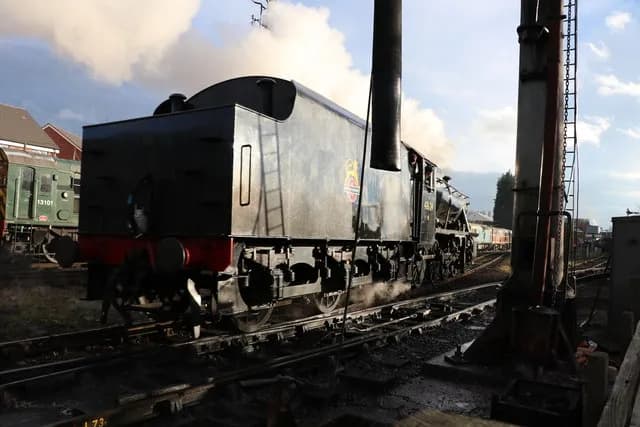
Fifty-five years ago, a group of railway enthusiasts gathered at Leicester Central railway station to fight what seemed an inevitable fate. Their mission was to save a stretch of track that represented the final flourish of Britain's Victorian railway age; their base of operations became Loughborough, and their legacy endures as one of the country's most remarkable heritage railway success stories.
The Last of Its Kind
The Great Central Main Line occupies a unique place in British railway history. It was the last complete main line railway to be built in Britain during the Victorian era, opening for passenger traffic on 15 March 1899. The project was the brainchild of Sir Edward Watkin, the ambitious chairman who dreamed of a railway that might one day run through a Channel Tunnel to France. The Manchester, Sheffield and Lincolnshire Railway changed its name to the Great Central Railway by Act of Parliament on 1 August 1897, completing its London Extension in just six years.
Yet this engineering marvel proved short-lived. British Railways withdrew express services beyond Nottingham in 1960, and the Beeching Report sealed its fate, describing the line as "a duplicate of the Midland Main Line." Passenger services between Aylesbury and Rugby ceased on 3 September 1966, and the final diesel multiple-unit service between Rugby Central and Nottingham Arkwright Street made its last run on 3 May 1969. The era seemed to have ended.
A Grassroots Movement Takes Shape
The Main Line Preservation Group formed in 1968 with a clear ambition: to acquire a suitable length of main line for the operation of steam-hauled passenger trains at realistic speeds. Local opposition to the closure had already drawn crowds to Leicester Central, and from those meetings emerged an organisation that would transform Loughborough's railway future.
In 1970, the group secured a lease on Loughborough Central station, its buildings, and most of the trackbed. This became the base of operations for what would become a pioneering preservation effort. The following year, after successful negotiations, the group purchased the railway for £75,000. British Rail had reassessed the eight miles of up line at £279,000, making the acquisition a considerable financial victory for the fledgling trust.
From Disused Station to Living Museum
Loughborough Central reopened in March 1974, and the first passenger train since commercial closure ran on 30 September 1973, hauled by LMS Stanier Class 5 4-6-0 No. 5231. Great Central Railway (1976) PLC was formed to hold the land and track, with the Main Line Steam Trust established as a supporting charitable body.
What distinguishes the Loughborough heritage railway from others is its operational authenticity. The line runs for eight miles between Loughborough and Leicester North, with four stations restored to distinct periods in the railway's commercial history. Loughborough Central itself presents the station as it appeared in the 1950s, while Quorn and Woodhouse evokes the Second World War era, Rothley reflects the Edwardian period, and Leicester North represents the 1960s.
More significantly, the Great Central Railway holds a distinction no other heritage railway in Britain can claim: it operates on double track throughout. When the double track between Loughborough and Rothley opened on 1 June 2000, it created what remains the UK's only double-track main line heritage railway. Her Majesty's Rail Inspectorate has granted powers to run test trains at up to 60 mph; even public special trains operate at up to 45 mph, whilst most heritage railways are limited to 25 mph. This allows the unique spectacle of full-size steam engines passing one another at speed.
The Loughborough Gap and the Future
The preservation story in Loughborough continues to evolve. Approximately 500 metres separate the Great Central Railway to the south from the Great Central Railway (Nottingham) to the north, a gap that has become the focus of one of British railway preservation's most ambitious projects.
The work has required remarkable engineering solutions and substantial fundraising. A new single-track bridge over the Midland Main Line was completed in 2017 at a cost of roughly £3 million, designed to accommodate future electrification. Refurbishment of the bridge over the Grand Union Canal followed in 2020, costing £475,000. Most recently, in October and November 2022, the existing bridge over the A60 was replaced with a new twin-track structure at a cost exceeding £1 million.
When the Loughborough Gap is finally bridged, the two railways will merge to create a single 18-mile track. This would represent the most significant expansion of heritage railway operations in Britain since the original preservation movement of the 1960s and 1970s.
Award-Winning Heritage
The quality of the restoration work has not gone unnoticed. The Great Central Railway received the NRHA Signalling Award on 5 December 2012 for the double-tracking project, and the Swithland Sidings project reached completion in May 2012. The Mountsorrel Railway project, opened to the public in October 2015 by Richard Faulkner, Baron Faulkner of Worcester, extended the railway's reach further into the Leicestershire countryside.
What began as a defensive effort to prevent the demolition of a redundant railway has become one of Loughborough's most distinctive cultural assets. The Great Central Railway attracts visitors from across Britain and beyond, offering an experience unavailable anywhere else: the sight and sound of express steam locomotives running at speed on a double-track main line, just as they did when the Great Central first opened in 1899.