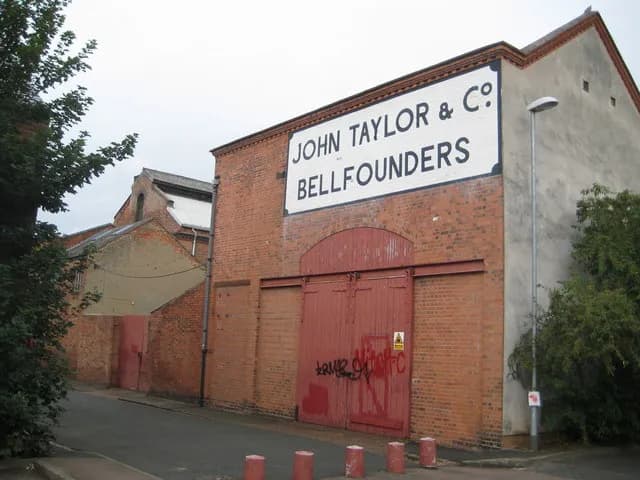
On Freehold Street in Loughborough, a Grade II* listed Victorian foundry continues a craft that has all but vanished from Britain. John Taylor & Co remains the only bell foundry still operating in the United Kingdom, and the world's largest working bell foundry still casting today.
A Foundry Steeped in History
The Taylor family's connection to bell founding stretches back centuries, with origins traceable to the 14th century through Johannes de Stafford. The current enterprise was established by John Taylor in 1839, with operations moving to the Freehold Street location in 1859. For over 185 years, bells cast in this Loughborough foundry have sounded across more than 100 countries worldwide, with over 25,000 bells leaving the site since its establishment.
The foundry buildings themselves are significant heritage assets. As one of the few Victorian purpose-built manufacturing sites still used for its original purpose, the complex has been recognised for its architectural and historical importance. The buildings were previously listed on Historic England's Heritage at Risk register, prompting a major restoration effort that has since secured their future.
Bells That Made History
Several of Britain's most famous bells were cast on Freehold Street. "Great Paul" at St Paul's Cathedral in London, weighing 17,002 kilograms, remains the heaviest bell ever cast at Taylor's and the second heaviest in the United Kingdom. Liverpool Anglican Cathedral's "Great George," cast in 1940, weighs 14,900 kilograms and ranks as the third largest bell in Britain.
York Minster's "Great Peter," cast in 1927, holds a unique distinction as the deepest toned hour bell in the UK and the heaviest bell still rung manually in the country. The foundry's reach extends well beyond religious institutions; a two-thousand-pound bronze bell cast at Taylor's famously accompanied AC/DC on their 1980 Back in Black Tour.
Crisis and Community Rescue
The foundry faced a precarious moment on 18 September 2009, when it entered administration with 26 employees at risk. The closure of Britain's last bell foundry appeared imminent. However, a consortium led by bell-ringer and industry expert Andrew Wilby formed UK Bell Foundries Ltd and purchased the company out of administration.
Trading resumed on 19 October 2009 under the name John Taylor & Co. This rescue preserved not only skilled manufacturing jobs in Loughborough but also the specialised knowledge accumulated over nearly two centuries of continuous operation. Some employees have served more than 40 years at the foundry, passing techniques from one generation to the next.
Heritage Restoration
The preservation effort gained significant momentum in 2014, when English Heritage provided a £1 million emergency repair grant for the deteriorating buildings. Two years later, the Loughborough Bellfoundry Trust was established as a charitable incorporated organisation. In a significant gesture, the directors transferred ownership of the buildings, equipment, intellectual property, and museum to the Trust in perpetuity.
The National Lottery Heritage Fund awarded nearly £4 million in 2020 as part of a £6 million total restoration project. This investment has since seen the buildings removed from the Heritage at Risk register, ensuring the foundry can continue operating for decades to come.
How the Foundry Operates Today
Approximately 30 staff continue the work of casting, restoring, and tuning bells for clients worldwide. The foundry has embraced modern technology alongside traditional craft, with computer-aided design complementing techniques that have changed little since the Victorian era.
The company maintains an extensive archive containing records for over 10,000 church towers. Its technical innovations include pioneering "true-harmonic" tuning in the late 19th century, a method that remains industry standard. John Taylor International, established in 2018 and based in Australia, now handles southern hemisphere markets.
Visiting the Foundry
The Loughborough Bellfoundry Trust operates the only bell founding museum of its kind in Britain. Visitors can tour the working foundry and museum by advance booking. Tours operate Tuesday through Friday from April to October, with reduced winter hours from November to March.
Ticket prices vary by tour type, with classic tours starting at £20 for adults and £15 for children aged nine to fifteen. Museum-only entry is available at £5 for adults and children over twelve; children eleven and under enter free. Group tours are available for parties of ten or more.
The foundry represents a rare example of living industrial heritage, where traditional manufacturing continues alongside heritage preservation. For Loughborough residents, it remains both a significant local employer and a connection to a craft that has shaped the soundscape of Britain and beyond for nearly two centuries.