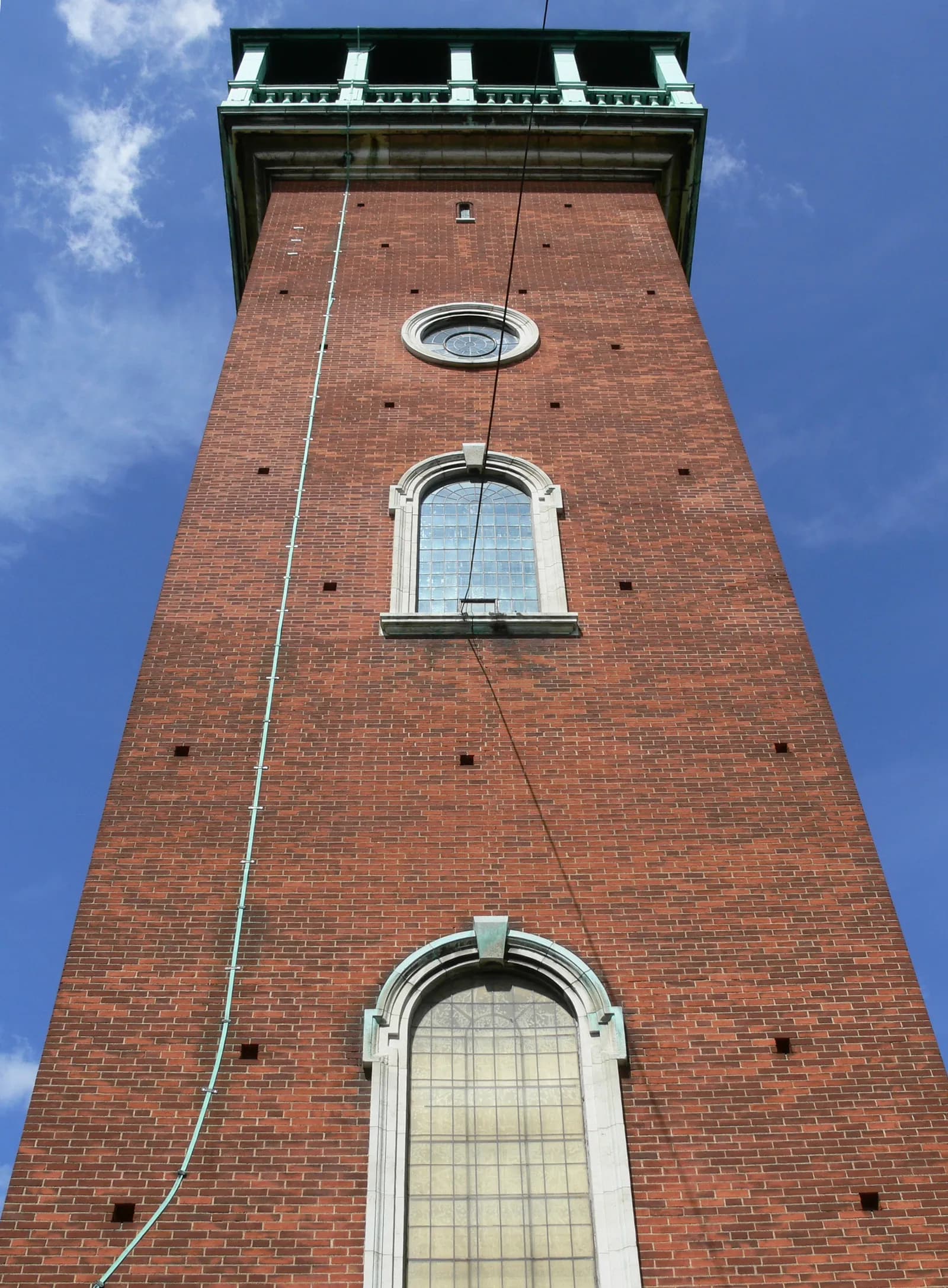
Rising 152 feet above Queen's Park, the Loughborough Carillon stands as both a solemn tribute and a remarkable feat of campanological engineering. When its 47 bells first rang out on 22 July 1923, they marked not only the remembrance of 478 local men who fell in the First World War but also a milestone in English musical history: England's first four-octave carillon.
A Community Memorial Born from Tragedy
At the end of the First World War, the citizens of Loughborough faced the question of how to honour the 478 men from the town who had lost their lives in the conflict. Rather than opting for a traditional statue or cenotaph, they chose a carillon: a musical instrument of bells played from a keyboard, an instrument with deep roots in the Belgian fields of Flanders where so many British servicemen had died.
The memorial was funded not by a single benefactor but by the community itself. Through a public "Buy a Bell" campaign, workplace contributions and individual donations, residents raised over £7,000 by May 1920. Local firms contributed significantly: Brush and William Moss and Sons Ltd each pledged £500. The Taylor's Bell Foundry, which had been based in Loughborough since 1839, donated £2,000 towards the bells and cast all 47 of them on site.
The total cost reached £20,000, a substantial sum that reflected the town's collective determination to create something permanent and meaningful.
Architecture and Engineering
The tower was designed by Sir Walter Tapper, a leading Gothic Revival architect who would later serve as President of the Royal Institute of British Architects and be knighted KCVO in 1935. Tapper's design stands as a Grade II listed building, constructed by William Moss and Sons Ltd of Loughborough.
The 47 bells represent a landmark in English bell-making. With a total weight of 21,337 kilograms, the largest bell (the bourdon) weighs 4,211 kilograms and was gifted by Edmund Denison Taylor, whose inscription reads: "In proud and loving memory of his three nephews, killed in action in France." The Taylor family's connection to the tower extends deeper: John William Taylor, who headed the foundry, had lost four sons in the war, making the bourdon's dedication particularly poignant.
When completed, the Loughborough Carillon became England's first four-octave carillon: a range spanning approximately four octaves and playable across 47 bells. The instrument is transposed down four semitones, meaning keyboard C sounds as A flat. This was cutting-edge campanological technology for its time.
The Belgian Connection
The choice of a carillon carried symbolic weight. Carillons are traditionally associated with Belgium, particularly the Flanders region where so many British soldiers lost their lives during the 1914–1918 conflict. The Belgian city of Mechelen is considered the home of the carillon tradition, and its influence is felt in Loughborough to this day.
The inaugural recital on dedication day, 22 July 1923, was performed by Jef Denyn, the city carillonneur from Mechelen, who travelled to Loughborough for the occasion. The ceremony, led by Field-Marshal Sir William Robertson and Theodore Woods, Bishop of Peterborough, also saw the premiere of a specially composed work: Edward Elgar's "Memorial Chimes," written specifically for the event.
The Elgar manuscript was later donated to Charnwood Borough Council in the 1950s, though it was temporarily misplaced and only rediscovered in 2012. Today it stands as one of the tower's treasured historical documents.
The Instrument and How It Is Played
The carillon is played manually from a keyboard of wooden batons struck with the fists, with a pedal keyboard controlling the lowest one-and-a-half to two-and-a-half octaves. Stainless steel wires transmit the player's movements to the clappers inside each bell. Unlike some carillons that feature automated systems, Loughborough's bells require a human carillonneur.
Current players include Caroline Sharpe, assisted by Dr Lynne Morgan, who continue the tradition of regular recitals. The instrument has also found its way into popular culture: one of the bells was used to record the opening of AC/DC's "Hells Bells," and the indie rock band Young Knives referenced the tower in their song "Loughborough Suicide."
Still Ringing Today
Nearly a century after its dedication, the Loughborough Carillon remains fully operational. Summer recitals take place every Sunday and Thursday from 1pm to 2pm between Easter and the end of September. During winter months, recitals occur on the first Thursday of each month.
The tower also houses the War Memorial Museum, which opened in November 2001. Spread across three floors, the museum displays the Leicestershire Yeomanry collection on the first floor and artefacts from both world wars on the second. The ground floor remains accessible to all visitors, though the upper floors and playing cabin are reached only by spiral staircase.
From Good Friday to 30 September, the tower is open daily except Mondays from 1pm to 4:30pm. The museum operates from Wednesday to Saturday, 11am to 4pm, closing briefly on Thursday afternoons during recitals.
The tower underwent significant restoration between 2018 and 2019, coinciding with the centenary of the Armistice and the Carillon's own approaching centenary in 2023. Work included repairs to the copper roof, windows, clavier and the bells themselves, ensuring that the instrument will continue to ring across Queen's Park for generations to come.